

JUMP TO :
JUMP TO :
Retirement Calculator India 2026: How Much Do You Need to Retire?
Retirement Calculator
Find out how much you need to retire comfortably based on your lifestyle.
years old
Include rent, groceries, healthcare, travel & lifestyle
₹50,000 /month
₹5K₹2.5L₹5L
⚠️ Please enter a valid age between 18 and 59.
—
Retirement Corpus Needed
—
To hit this goal, save every month
—
starting today via SIP / investments
*Assumes 6% inflation · 10% pre-retirement returns · 7% post-retirement returns
Retirement at 60 · Life expectancy 85 years
Planning for retirement in India is essential, not optional. With rising living costs, longer life expectancy, and limited social security, your future depends on how well you prepare today.
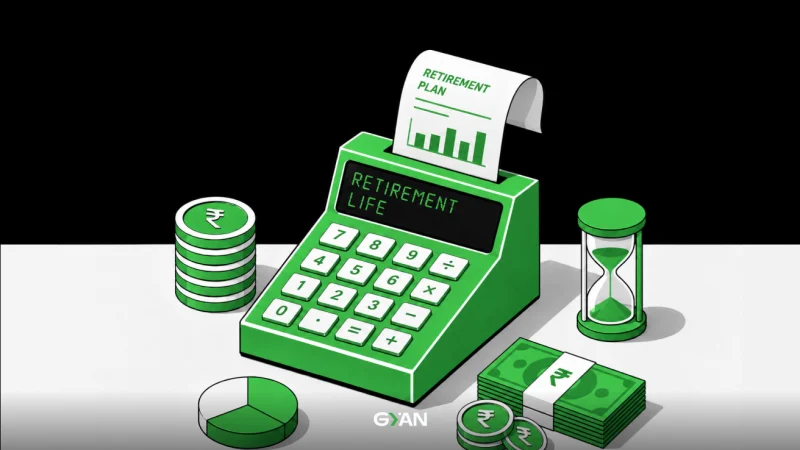
A retirement calculator helps you estimate how much money you need to retire in India based on your lifestyle, expenses, inflation, and expected returns. It gives you a clear retirement corpus and reveals how much you should exactly save every month to reach that goal.
Whether you’re in your 20s starting early or in your 40s catching up, this blog will walk you through everything you need to know about retirement planning in India.
Why Retirement Planning Is Important in India
Retirement planning in India matters because your future lifestyle, healthcare, and financial independence depend entirely on your savings and investments.
Most Indians subconsciously believe ‘retirement is far away’ or ‘I’ll save when I earn more.’ That belief is what keeps millions underprepared. So technically, the biggest barrier to retirement planning isn’t lack of knowledge. It’s your money mindset.
Once that shift happens, it becomes easier to look at the real factors that shape your retirement.
Limited Social Security Benefits
Unlike some countries that provide robust government pensions, India doesn’t have a strong social security system for retirees. This means your financial independence largely depends on your savings and investments.
Rising Life Expectancy
People are living longer, healthier lives, which is great. But it also means your retirement fund needs to last longer. With proper early retirement planning in India, you can rest assured you’re covered for decades beyond your working years.
Increasing Healthcare Costs
Medical expenses rise with age, and India’s healthcare inflation has been consistently higher than general inflation. Ignoring health costs in your retirement plan can eat into your nest egg faster than you think.
Impact of Inflation on Savings
Money saved today might not hold the same value tomorrow. Incorporating inflation-adjusted retirement planning ensures that your retirement corpus maintains its purchasing power over the years.
How Much Money Do You Need for Retirement in India?
If you’re wondering how much money you need to retire in India, the answer depends on your future expenses, inflation, and how long your money needs to last. A retirement calculator helps you estimate this number and plan accordingly.
These are the factors you need to take into account:
Monthly Expenses After Retirement
Start by estimating your monthly expenses after retirement in India. Groceries, utilities, travel, hobbies, and unexpected costs can all add up. Don’t forget to factor in lifestyle inflation and any additional luxuries you might want.
Inflation
Inflation is the silent wealth-eroder. Even a modest 6–7% inflation rate can drastically reduce your money’s value over 20–30 years.
Pro Tip:
Consider multiple income scenarios. Use your retirement calculator to model “best case,” “average case,” and “worst case” returns. This way, your plan stays flexible even if markets underperform.
Expected Investment Returns
Your retirement corpus grows through careful investing. Realistic assumptions for returns from EPF (Employee Provident Fund), PPF (Public Provident Fund), NPS retirement (National Pension System), and SIP for retirement can guide your savings strategy. Diversifying across instruments balances risk and guarantees steady growth.
Retirement Duration
Think about how many years you’ll spend in retirement. Planning for at least 25–30 years after your retirement age gives you a safety buffer. Tools like our retirement savings calculator in India can simulate different scenarios, helping you make informed decisions.
How to Calculate Your Retirement Corpus?
To put all of this into perspective, let’s walk through a simple example.
Assume you’re 30 years old, living in a metro city, and spending about ₹50,000 a month today and hoping to retire by 60 years old (30 years from now). You want a “Comfortable” lifestyle in retirement, one that includes travel, dining out, and enjoying your time without financial stress. That typically means planning with an inflation rate of around 7%.
Step 1: Adjusting for Inflation
What feels like ₹50,000 today won’t stay the same over time. With 30 years to retirement, inflation does its work in the background.
Future Monthly Expense = 50,000 × (1.07)³⁰ = ₹3,80,612
In simple terms, the lifestyle you maintain today at ₹50,000 per month could cost you nearly ₹3.8 lakhs per month by the time you retire.
Step 2: Calculating Your Retirement Corpus
Next, we translate that monthly expense into a long-term retirement fund.
Annual Expense = ₹3.8 lakhs × 12 ≈ ₹45.6 lakhs
To sustain this over a long retirement period, we use a 3.5% withdrawal rate, along with a 10% buffer for taxes and market realities. The 3.5% withdrawal rate assumes that your corpus continues to earn returns slightly above inflation, allowing it to last for 25–30 years.
Corpus = (45.6 lakhs ÷ 0.035) × 1.10 = ₹14.35 crores
So to maintain a “Comfortable” lifestyle, you would need a retirement corpus of roughly:
👉 ₹14 crores by age 60
If the same 30-year-old spending ₹50k changed their “Retirement Vibe,” here is how the corpus would shift:
When Should You Start Retirement Planning?
The best age to start retirement planning in India is as early as possible (ideally in your 20s). The earlier you begin, the more compounding works in your favor. Even if you start later, disciplined investing can still help you build a strong retirement corpus.
Retirement planning often gets delayed not because of a lack of understanding, but because something else always feels more urgent.
Rent, EMIs, lifestyle upgrades, responsibilities. Retirement moves to the background.
The Millionaire Mind Intensive (MMI) focuses on helping you reset these priorities, reducing delays in financial decision-making.
Here’s a breakdown of how starting at different ages affects your plan:
Starting in Your 20s
This is truly the golden window for early retirement planning in India. Even small monthly investments can grow exponentially over decades. For instance, contributing ₹5,000 per month to a SIP for retirement or combining it with EPF and PPF can translate into a substantial corpus by age 60.
Starting in Your 30s
If you’re starting in your 30s, the power of compounding is still on your side, but you’ll need slightly higher monthly contributions. Combining traditional instruments like PPF and EPF with mutual fund SIPs can help catch up. At this stage, it’s critical to review your expected post-retirement monthly expenses and adjust your savings accordingly.
Starting in Your 40s
Late starters need to adopt a more disciplined and aggressive approach. Maximize contributions to EPF, PPF, and NPS retirement, while adding SIP for retirement in diversified mutual funds. Consider tax-advantaged options like ELSS (Equity Linked Savings Schemes) funds to boost returns, especially if opting for the Old Tax Regime.
Is It Ever Too Late to Start?
Even if you’re past 50, starting is better than doing nothing. Focus on high-yield but safer options like PPF, certain NPS retirement segments, or fixed deposits combined with annuities.
Reduce discretionary spending, leverage tax benefits under Section 80C and 80CCD(1B) if you are under the Old Tax Regime, or focus on employer-contribution benefits under Section 80CCD(2) if you have switched to the New Tax Regime.
Best Retirement Investment Options in India
The best retirement plans in India typically include EPF, PPF, NPS, and SIP to build a balanced and reliable retirement corpus.
The key is to diversify across risk levels, timelines, and returns while aligning with your long-term goals.
Employee Provident Fund (EPF)
A foundational tool for salaried employees, EPF offers steady, compounded growth with tax benefits under Section 80C. It ensures disciplined, long-term retirement savings.
Public Provident Fund (PPF)
A safe, government-backed option with tax-free returns and a 15-year lock-in. Ideal for conservative investors and works well alongside SIP for retirement.
National Pension System (NPS)
A flexible retirement-focused investment with exposure to equity, debt, and government securities. It offers additional tax benefits and helps build long-term retirement wealth.
Mutual Fund SIPs
SIPs allow consistent investing and are ideal for long-term growth. Starting early can significantly boost your retirement corpus through compounding.
Stocks and Bonds
Equities offer higher long-term returns, while bonds provide stability. Together, they help balance risk and generate passive income after retirement.
Fixed Deposits & Annuities
These are low-risk options that provide stable, predictable income. Best suited for preserving capital and covering post-retirement monthly expenses.
Tax Benefits for Retirement Planning in India
Tax benefits for retirement planning in India help you reduce your taxable income while building your retirement corpus. Investments like EPF, PPF, NPS, and ELSS offer deductions and tax-efficient growth.
A well-structured plan helps you see how tax-efficient investing improves your long-term numbers.
Section 80C Investments
Under Section 80C, contributions to EPF, PPF, and ELSS qualify for deductions up to ₹1.5 lakh per year (if you opt for the Old Tax Regime). That means you reduce your taxable income while building your retirement fund.
NPS Tax Benefits
The NPS retirement route gives you an additional ₹50,000 deduction under Section 80CCD(1B), over and above the 80C limit under the Old Tax Regime. This makes it one of the most tax-efficient long-term retirement options available.
ELSS Funds
ELSS funds offer tax benefits under 80C (in the Old Tax Regime) with a shorter lock-in period of three years. They invest in equities, so returns can be higher over the long term. For investors comfortable with market fluctuations, ELSS can support growth while still offering tax savings.
Tax-Free Returns Options
Certain instruments like PPF provide tax-free maturity proceeds (EEE status), which makes them attractive for long-term planning. A mix of taxable and tax-efficient investments helps your withdrawals better support your monthly expenses after retirement in India.
Common Retirement Planning Mistakes to Avoid
Common retirement planning mistakes in India include ignoring inflation, delaying investments, and not diversifying across options like EPF, PPF, and SIP, which can impact your final retirement corpus.
- Ignoring Inflation: Your corpus may fall short if you don’t adjust for rising costs.
- Not Starting Early Enough: Late planning means you need higher monthly contributions.
- Overestimating Government Support: Limited social security means self-reliance is key.
- Investing Without Diversification: High-risk or low-return concentration can hurt long-term growth.
Neglecting Healthcare and Insurance: Medical emergencies can quickly erode savings.
Key Takeaways
Retirement feels far away… until it suddenly doesn’t. One day you’re planning your next appraisal and the next you’re wondering how many working years you actually have left. That’s why retirement planning in India deserves your attention now, not “someday.”
The good news? You don’t need to be a finance expert or a market wizard to get this right. Consistent investing, smart choices like EPF, PPF, NPS, and SIPs, and a clear idea of your future expenses can go a long way.
But knowing all of this is only half the equation.
Numbers tell you what to do. Your mindset determines whether you actually do it.
If you’ve read this far and still feel stuck or unsure, the Millionaire Mind Intensive (MMI) might be the missing piece. Thousands of Indians have used it to go from financial anxiety to financial clarity.
And once your mindset is set, you can always come back and use a retirement calculator to build your actual plan.
Frequently Asked Questions (FAQs)
Recommended posts



Related Content





Millionaire Mind Intensive is about unlocking your financial freedom and strengthening your relationship with money.
Quick Links
Contact Info
Success Gyan India LLP
S5, Thiru Vi Ka Industrial Estate,
Guindy, Chennai – 600032